
Professional services — teaching case
Immigration services: an AI operations teaching case
Five workspaces demonstrate governed content acquisition, advisory sales, partner access, client cases and management reporting.
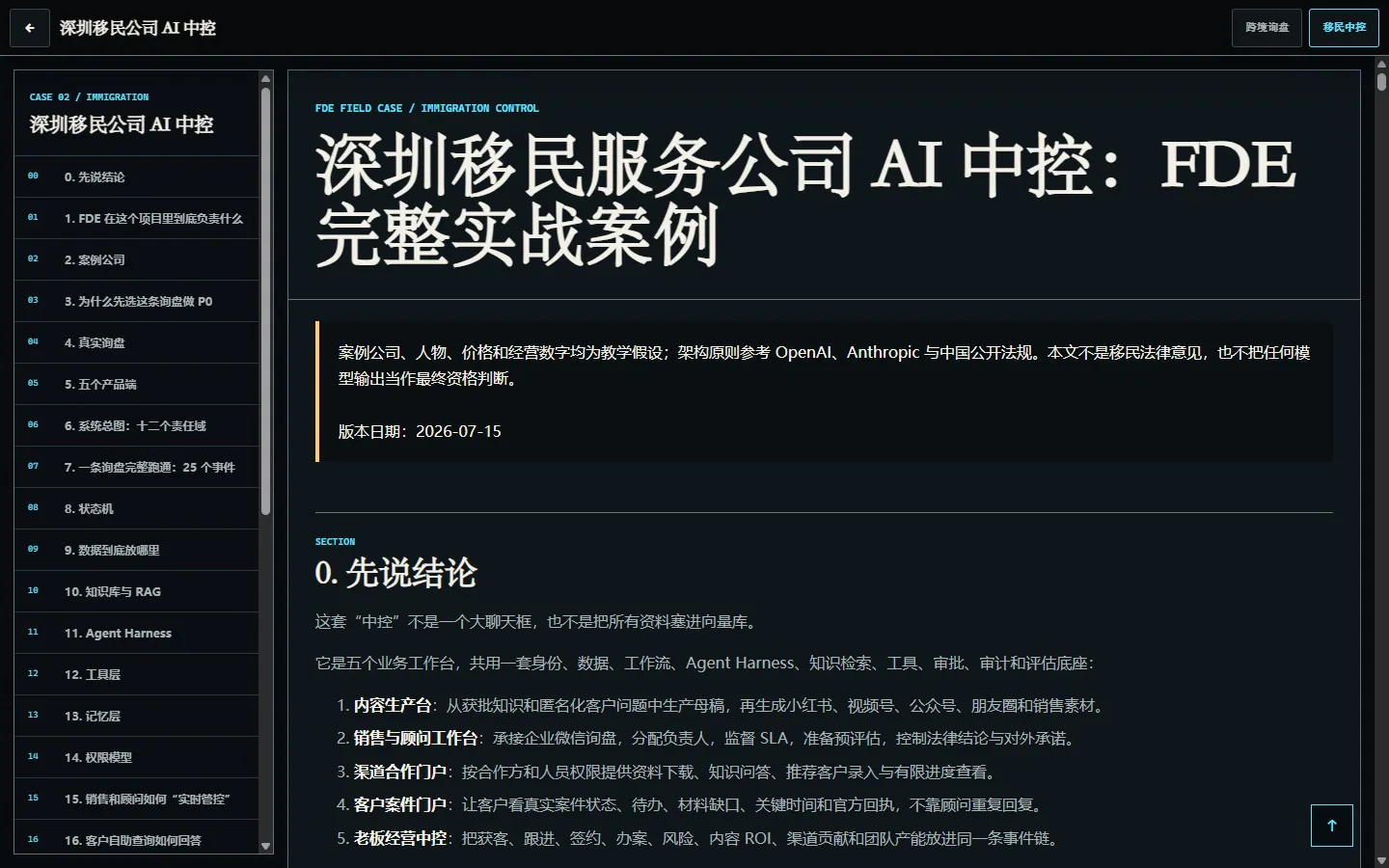
Five workspaces demonstrate governed content acquisition, advisory sales, partner access, client cases and management reporting.
Duplicate leads, outdated policy, scattered sensitive documents and limited progress visibility make the service difficult to govern.
Consent, lead deduplication, secure upload, reviewed evidence, policy approval and purpose-scoped portals connect the service stages. Formal cases follow approved contracts and confirmed payments.
This teaching case models responsibility domains, retrieval and approval matrices around multiple roles, portals and case states, illustrating system modeling for complex professional-service organizations.
AI methods
BUSINESS_OS / CONSENTED_INTAKE / CASE_PORTAL / CONTENT_FLYWHEEL / EXECUTIVE_ANALYTICS
Workflows, pipelines and agents
Five business workspaces / Identity and consent / Authoritative CRM and case records / Agent Harness / Retrieval and tools / Approvals and analysis
Purpose-specific consent is recorded before sensitive data collection. Passport, financial, marital and minor-related records use encrypted object storage, virus scanning and organization/case ACLs, with consent withdrawal, retention periods and audits.
This is a teaching architecture for discussion and rehearsal, not a public claim of client delivery or immigration outcomes.
This public project account describes documented work and its current stage. It does not imply independent verification, client endorsement or unreported commercial results.